




Gov. Kathy Hochul’s recent Executive Order No. 62, enacting a first-in-the-nation, one-year moratorium on large scale data centers, is the state’s most recent move to address the advancement of artificial intelligence and determine where infrastructure fits in New York’s plans for this rapidly evolving industry.
With an executive pause now in place, the governor should veto a more expansive legislative moratorium, called the Responsible Data Center Development Act, which would cover smaller data centers and include regulation of renewable energy use, utility rates, labor standards and community benefits.
Under the executive order, the relevant state agencies can and should streamline their review to develop a clear and predictable regulatory framework for infrastructure investment. The interrelated and at times complex issues with data center development, coupled with the rapid evolution of AI technology, demands the kind of administrative flexibility and persistent expert collaboration better suited for agency action.
At the recent Converge ‘26 Hudson Valley Digital Innovation Conference, the Westchester County Association convened industry authorities instrumental in building out the Chicago Quantum Exchange alongside local leaders. These experts confirmed that New York is uniquely poised to become a leading hub in the AI industry, particularly in the realm of applied AI, which links frontier models to real-world applications.
New York has a massive tech footprint and deep talent pool anchored by top-tier research hubs. For its part, Westchester County, while often overlooked as a global destination for pure research, has a large concentration of enterprise customers. It is home to IBM and its quantum headquarters as well as numerous other Fortune 500 companies that can directly exploit AI for supply chain productivity and information analysis. It also has diverse market verticals in an array of industries such as healthcare and life science, finance, media, real estate and government.
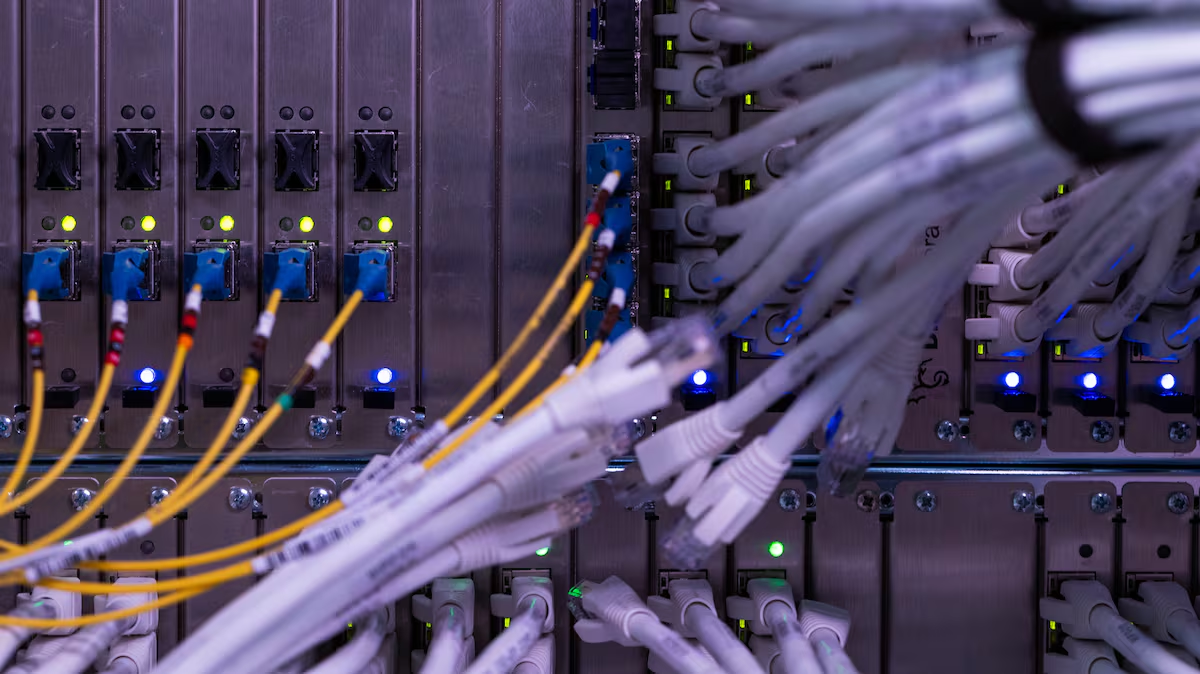
Data centers are a big part of the physical backbone behind an ongoing technological revolution which businesses and consumers are harnessing through AI applications. Although “hyperscalers” may not focus on Westchester, the county is home to several smaller data centers and can expect next-generation modular “edge” centers to be distributed throughout the region to meet the latency and entanglement needs of AI and quantum networks.
During the pause on state-issued permits for large data centers, several state agencies will develop a regulatory roadmap for energy demands, interconnection and grid reliability, utility ratepayer differentiation, water conservation, community investment, model zoning codes and tax incentives, just to name a few.
New York can lead by setting parameters to ensure these projects are developed responsibly, with new private power-production opportunities, advanced cooling technologies and economic reinvestment in host communities. That kind of framework would complement the state’s commitment to the technology sector through partnerships and investments in chip manufacturing and quantum computing power.
States that lead the AI economy will be the ones that set the smartest ground rules. Absent federal action, moratoriums in other states are likely to follow. While first-to-market is good, a clear and predictable regulatory framework is better. Perhaps being first to pause means New York will end up ahead.
So, while New York’s cautious approach will temporarily slow momentum, it could accelerate development moving forward. But if we miss the window, a massive flow of capital investment will skip us over. A moratorium is not policy. Policy is what comes next. It should facilitate the responsible infrastructure New York needs in an AI and quantum future.
Michael N. Romita is the president and CEO of the Westchester County Association. Chris Fisher is a partner at Cuddy & Feder and chair of the Westchester County Association.